
Can You Keep Your Doctor With Medicare Advantage?
If you’re comparing Medicare Advantage plans — or thinking about switching from the one you have now — one question usually matters more than any other: will you still be able to see your own doctor? It’s a fair worry. Medicare Advantage plans work through provider networks, and not every doctor, specialist, or hospital participates in every plan.
The good news is that checking this ahead of time is usually straightforward once you know what to look for. We’ll walk through what a provider network actually is, how to check whether your doctors and preferred hospitals are included, what happens if you end up seeing someone outside the network, and how referrals work if you’re considering an HMO-style plan.
How Do You Check Whether Your Doctor Is In-Network?
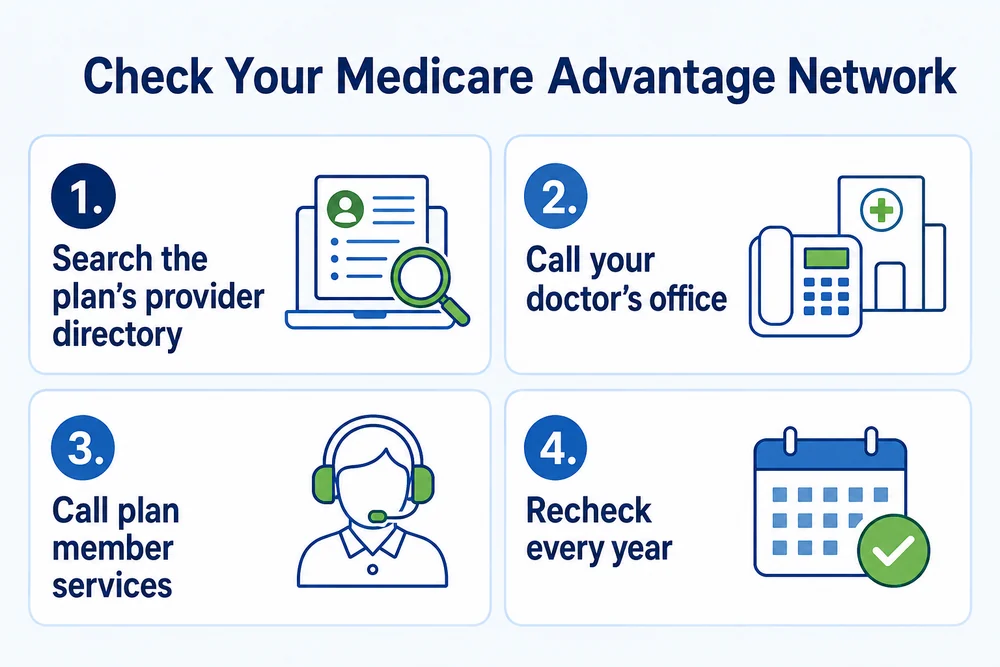
To find out if your doctor is in-network with a Medicare Advantage plan, start with the plan’s online provider directory, then call your doctor’s office directly to confirm they currently accept that specific plan. You can also call the plan’s member services line to double-check, since directories can lag behind actual provider participation. Recheck each year, since networks can change from one plan year to the next.
What Is a Medicare Advantage Provider Network?
A Medicare Advantage provider network is the group of doctors, specialists, hospitals, and other providers that a specific plan has agreements with. Unlike Original Medicare, where you can generally see any provider that accepts Medicare, a Medicare Advantage plan’s network can shape which doctors and facilities are covered — and how much you pay to see them.
Here in Knoxville, that often means checking whether local systems like UT Medical Center or Covenant Health participate in a plan’s network, along with your own primary care doctor and any specialists you see regularly. Each plan that uses a provider network builds its own, so participation can vary quite a bit from one plan to the next, even between two plans offered by the same company.
How to Check If Your Doctor or Hospital Is In-Network
Before you enroll in or switch to a Medicare Advantage plan, it’s worth confirming that your current doctors, specialists, and preferred hospitals are part of that plan’s network. A few ways to check:
- Search the plan’s own online provider directory using your doctor’s name or NPI number
- Call your doctor’s office directly and ask whether they currently accept that specific plan
- Call the plan’s member services line to confirm, since online directories can sometimes lag behind actual provider participation
- Recheck each year during Open Enrollment, since a plan’s network can change from one plan year to the next
It’s worth doing more than one of these checks rather than relying on a single source, especially since a doctor’s participation can occasionally differ from what’s listed online.
If you’re looking for a new doctor in the Knoxville area who accepts Medicare — rather than checking on a doctor you already see — Medicare’s Care Compare tool at Medicare.gov lets you search by specialty and location, and a plan’s own provider directory works the same way for Medicare Advantage. Either one is a solid starting point.
What Happens If You Go Out of Network
What happens if you see a doctor or hospital outside your plan’s network depends on the type of plan you have. HMO-style Medicare Advantage plans generally require you to use in-network providers, except for emergency care, out-of-area urgent care, and temporary out-of-area dialysis. Some HMO-POS plans may also cover certain out-of-network services, usually at a higher cost. PPO-style plans (Preferred Provider Organization plans) typically allow you to see out-of-network providers, but you’ll usually pay more out of pocket than you would in-network.
Because the details vary by plan, it’s worth understanding your specific plan’s out-of-network rules before you need care, not after. If your doctor or another healthcare provider leaves your plan’s network during the year, your plan must notify you — but it’s still worth checking periodically rather than waiting to be surprised.
Not ready to book a full consultation but have a question first? Talk with a local Medicare advisor.
Referrals and Specialist Access Under HMO Plans
Network rules don’t just affect which doctors you can see — they also shape how you get to specialists in the first place. If you’re considering an HMO-style Medicare Advantage plan, referrals are worth understanding up front. Many HMO plans require you to get a referral from your primary care doctor before seeing a specialist, and that specialist generally needs to be in the plan’s network as well. PPO plans are usually more flexible here — many don’t require a referral to see a specialist, though seeing one out of network may still cost more.
If you see specialists regularly — for an ongoing condition, for example — it’s worth thinking through how a plan’s referral rules and network might affect that relationship before you enroll.
Participating vs. Non-Participating Providers
You may also come across the terms “participating” and “non-participating” when comparing providers, and they mean something a bit different from being in or out of a Medicare Advantage plan’s network. A participating provider has agreed to accept Medicare’s approved amount as full payment for covered services. A non-participating provider can still treat Medicare patients but may charge up to a limited additional amount above what Medicare approves, which can affect your out-of-pocket cost.
This distinction applies most directly to Original Medicare billing, but it’s a term worth understanding generally as you compare your coverage and provider options, since it can come up in provider directories and billing conversations alike. If a term like this ever leaves you unsure what it means for your own situation, that’s exactly the kind of question we’re happy to walk through with you.